

2 Peas and a Dog
Grade 7/8 Science Unit Bundle
Grade 7/8 Science Unit Bundle
Couldn't load pickup availability
All prices are in Canadian dollars.
Total Pages: 2,300 Pages + Google Slides + Google Forms
Answer Key: Included with rubric
Teaching Duration: 1 Year
File Size: 628 MB
File Type: Zip
Are you a middle school science teacher in search of a comprehensive and captivating science program? Use this Grade 7/8 Science Bundle for the Ontario Curriculum. With 154 lessons at your disposal, you'll be equipped to engage and empower your students. Say goodbye to dry and dull textbooks and embrace this exciting 8-unit bundle, designed to make science come alive in your classroom.
Imagine your students' enthusiasm as they dive into topics like Interactions in the Environment, Heat in the Environment, Pure Substances and Mixtures, Understanding Structures and Mechanisms, Cells, Water Systems, Fluids, and Systems in Action. Each unit is carefully curated to foster a deep understanding of scientific concepts.
Curriculum Alignments:
- Curriculum Alignment: Ontario Science Curriculum 2022 Grade 7
- Curriculum Alignment: Ontario Science Curriculum 2022 Grade 8
Click Here To View The Preview
Resource Includes:
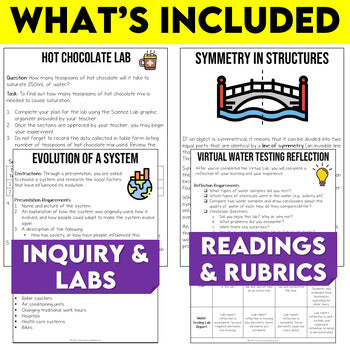
- Engaging Lessons: Keep your students actively participating and interested in science with thoughtfully designed lessons.
- MP3 Audio Files: Enhance student learning and accessibility by providing audio recordings of student readings.
- 8 Editable Teacher Slideshow (Google Slides™): A ready-to-use, customizable presentations to guide instruction.
- Detailed Lesson Plans: Well-structured lesson plans, which outline activities and resources for each day's lesson.
- Answer Keys: Save time on grading with readily available answer keys for assessments and activities.
- Differentiated Tasks: Tailored tasks and activities designed to meet students' individual learning needs.
- Student Choice: Empower your students by offering options and opportunities for them to make decisions about their learning.
- Graphic Organizers: Visual tools that help students organize information and better understand complex concepts.
- Assessment Rubrics: Easily assess student progress and understanding using ready-made rubrics.
- Quizzes: Check for comprehension and reinforce key concepts throughout the unit.
- Unit Tests: Gauge overall comprehension and retention with a comprehensive final assessment.
- 8 Digital Escape Rooms: Interactive digital challenges immerse students in problem-solving as they apply their knowledge to unlock clues and “escape,” perfect for review days, early finishers, or boosting engagement at the end of your unit.
- Sub Plans: Ready-to-use lessons to ensure continuity when you're away.
- Print and Digital Formats: Enjoy the flexibility of accessing materials in both traditional and digital formats, making it easy to adapt to various teaching environments.
- Editable Report Card Comments: Aligned to curriculum expectations to support efficient, accurate, and personalized student reporting
Modified Units: Do you have students working below grade level? Use the Grade 7/8 Science Modified Bundle, which aligns with the regular bundle, to ensure your modified IEP and ELL students can access the content and experience success alongside their peers.
Why Teachers Love These Resources:
- No-prep, ready-to-teach lessons that save you hours of planning time
- Engaging activities that keep even reluctant learners motivated and participating
- Differentiated tasks that make it easy to support all learners in your classroom
- Strong cross-curricular connections
- Flexible print and digital formats
Perfect For:
- Grade 7/8 Ontario Science classrooms
- Teachers without a textbook
- Teachers looking for low-prep, high-engagement science units
Interactions in the Environment Unit Lesson Overview:
- Introduction: Safety Rules
- Lesson 1: Unit Vocabulary (Tech & No-Tech Versions)
- Lesson 2: Elements of Ecosystems
- Lesson 3: Ecosystems - Examples and Interactions
- Lesson 4: Energy Transfer and Food Chains
- Lesson 5: Biotic Elements Quiz
- Lesson 6: Matter Cycling
- Lesson 7: Ecological Succession
- Lesson 8: Ecosystem Limits
- Lesson 9: Species at Risk & Invasive Species
- Lesson 10A: Human Interactions in the Environment
- Lesson 10B: Agriculture and Ecosystems
- Lesson 11: Indigenous Perspectives
- Lesson 12: Environmental Investigation
- Lesson 13: Environmental Protection
- Lesson 14: Ecosystem Summative (Owl Pellet Lab, Terrarium Design Project, Design an Ecosystem Assignment)
- Lesson 15: Ecosystems Unit Test
- Bonus Files: Sub Plans/Unit Review
Heat in the Environment Unit Lesson Overview:
- Introduction: Safety Rules & Unit Vocabulary (Tech & No-Tech Versions)
- Lesson 1: Introduction to Heat
- Lesson 2: Heat Protection
- Lesson 3: Heat and Temperature
- Lesson 4: The Particle Theory
- Lesson 5: Heat and Volume
- Lesson 6A: Conduction, Convection, and Radiation
- Lesson 6B: Heat Video
- Lesson 7: Teacher Demonstration: Boiling Water in a Paper Cup
- Lesson 8: Student Lab: Melting Ice Cubes
- Lesson 9: Heating and Cooling of the Earth
- Lesson 10: Greenhouse Gases
- Lesson 11: Investigation: Benefits of Technology With Heat
- Lesson 12: Stations & Project-Based Learning: Energy Types & Solar Panels Investigation
- Lesson 13: Unit Test
- Lesson 14: Sub Plans - Net Zero Homes
Pure Substances and Mixtures Unit Lesson Overview:
- Introduction: Safety Rules & Unit Vocabulary (Tech & No-Tech Versions)
- Lesson 1: The Particle Theory
- Lesson 2: Pure Substances and Mixtures
- Lesson 3: Pure Substances and Mixtures Activity
- Lesson 4: Homogeneous and Heterogeneous Mixtures
- Lesson 5: Solutions and Solubility
- Lesson 6: Solution Examples Activity
- Lesson 7: Concentration of Solutions
- Lesson 8: Saturated Solutions
- Lesson 9: Saturation Lab
- Lesson 10: Separating Mixtures
- Lesson 11: Separating Mixtures Lab
- Lesson 12: Positive and Negative Impacts on the Environment
- Lesson 13: Tar Sands Investigation
- Lesson 14: Unit Test
- Lesson 15: Unit Review/Sub Plans
Understanding Structures and Mechanisms Unit Lesson Overview:
- Introduction: Safety Rules
- Unit Vocabulary (Tech & No-Tech Versions)
- Unit Introduction: Structures and Form
- Classifying Structures
- Structures Video Questions
- Centre of Gravity and Stability
- Force
- Show and Tell Assignment
- Classifying Structures Quiz
- Internal and External Forces
- Card Pyramid Activity
- Symmetry in Structures
- Structure Failure
- Manufacturing Factors
- Loads
- Structural Safety
- Design Factors
- Ergonomic Design
- Take-Out Container Lab
- Egg House Lab
- Unit Test
- Sub Plans: CN Tower
Cells Unit Lesson Overview:
- Introduction: Safety Rules
- Lesson 1: Unit Vocabulary (Tech & No-Tech Versions)
- Lesson 2: The Cell Theory
- Lesson 3: Structures and Organelles in Cells
- Lesson 4: Plant vs. Animal Cells
- Lesson 5: Create Your Own Cell - Plant or Animal Cells
- Lesson 6: The Process of Diffusion and Osmosis
- Lesson 7: Candy Diffusion & Potato Osmosis Experiments
- Lesson 8A: Unicellular and Multicellular Organisms
- Lesson 8B: Cellular Organisms Inquiry
- Lesson 9: Organization of Cells into Tissues, Organs, and Organ Systems
- Lesson 10: Inquiry - Organ Systems Infographic & Presentation
- Lesson 11: Mid-Unit Quiz
- Lesson 12: What is a Microscope?
- Lesson 13: Plant and Animal Cells Microscope Lab
- Lesson 14: Dry and Wet-Mount Slides
- Lesson 15: Stations - Cell Technology and Our Understanding of Cells
- Lesson 16: Perspectives on Cell Processes
- Lesson 17: Cells Final Unit Test
- Lesson 18A: Sub Plans: Organ Transplants
- Lesson 18B: Sub Plans: Unit Review Videos
Fluids
- Introduction: Safety Rules, Fluids Introduction & Unit Vocabulary
- Lesson 1. Particle Theory of Matter
- Lesson 2. What is Viscosity? and What is Flow Rate? Experiment
- Lesson 3A. Mass, Volume, and Density
- Lesson 3B. Calculating Density
- Lesson 4. Mass-to-Volume Ratio Experiment
- Lesson 5. Compressibility
- Lesson 6. Canada’s Wonderland Case Study
- Lesson 7. What is Buoyancy & Float or Sink Experiment
- Lesson 8. Mid-Unit Quiz
- Lesson 9. Pressure, Volume, and Temperature & Optional Experiment
- Lesson 10. Pascal’s Law
- Lesson 11. Fluids in Controlled and Manufactured Devices
- Lesson 12. Building a Pneumatic or Hydraulic Device (2 options)
- Lesson 13. Inquiry & Stations - Investigating Applications of Fluid Mechanics
- Lesson 14. Fluid Technologies Research Inquiry
- Lesson 15A. & 15B. The Impact of Fluid Spills
- Lesson 16. Fluid Systems Unit Test
- Lesson 17. Unit Review Videos
- Lesson 18. Sub Plans: Bottled Water
Systems in Action Unit Lesson Overview:
- Introduction: Safety Rules & What Are Systems?
- Lesson 1: Unit Vocabulary (Tech & No-Tech Versions)
- Lesson 2: Types of Systems
- Lesson 3: Purpose, Inputs, and Outputs of Systems
- Lesson 4: Processes and Components of a System
- Lesson 5: Systems in Action Quiz
- Lesson 6: Force, Work, Displacement, Energy, and Efficiency
- Lesson 7A: Calculating Work, Force, and Displacement
- Lesson 7B: Understanding and Calculating Work
- Lesson 8: The 6 Simple Machines
- Lesson 9: Mechanical Advantage
- Lesson 10: Systems in Action Mini Quiz
- Lesson 11: Energy in Mechanical Systems
- Lesson 12: Productivity With Systems in Various Industries
- Lesson 13: The Evolution of Cell Phones (with optional inquiry)
- Lesson 14: Systems in Action Mid-Unit Quiz
- Lesson 15: Pulley Experiment
- Lesson 16: Rube Goldberg Machine (Lab)
- Lesson 17: Stations - Owner’s Manual Exploration
- Lesson 18: Stations - The Impacts of New and Evolving Systems
- Lesson 19: Meeting Needs With Existing Systems - Different Perspectives
- Lesson 20: Systems in Action Unit Test
- Lesson 21: Unit Review Video
- Lesson 22: Sub Plans - Self-Driving Cars
Water Systems Unit Lesson Overview:
- Introduction: Safety Rules & Water Introduction
- Lesson 1: Unit Vocabulary (Tech & No-Tech Versions)
- Lesson 2: The Water Cycle
- Lesson 3: Watersheds
- Lesson 4A: Human and Natural Factors
- Lesson 4B: Human and Natural Factors - Inquiry Project
- Lesson 5: Factors That Affect Glaciers and Polar Ice Caps
- Lesson 6: Atmospheric Conditions and Bodies of Water
- Lesson 7: Mid-Unit Water Systems Quiz
- Lesson 8: Water Treatment Plant Investigation
- Lesson 9: Testing Water Samples Experiment (3 Options)
- Lesson 10: Investigating Local Water Issues
- Lesson 11: First Nations, Métis and Inuit Water Knowledge
- Lesson 12: Building a Water System Device
- Lesson 13: Human Impact on Water Consumption
- Lesson 14: Water Technology Innovation
- Lesson 15: Water Systems Unit Test
- Lesson 16: Unit Review Videos
- Lesson 17: Sub Plans - AI Data Centres
Join countless educators who have already transformed their science lessons with this Grade 7/8 Science Bundle. Ignite a passion for science, foster critical thinking, and unleash the potential of your students. Get ready to embark on a scientific adventure like no other!
Grade 7 Science Units:
- Grade 7 Science Interactions in the Environment
- Grade 7 Science Heat in the Environment
- Grade 7 Science Pure Substances and Mixtures
- Grade 7 Science Understanding Structures and Mechanisms
Grade 8 Science Units: